
A fascinating article about targeting fish in murky water (big thanks to Active Angling New Zealand for letting me reproduce it here)
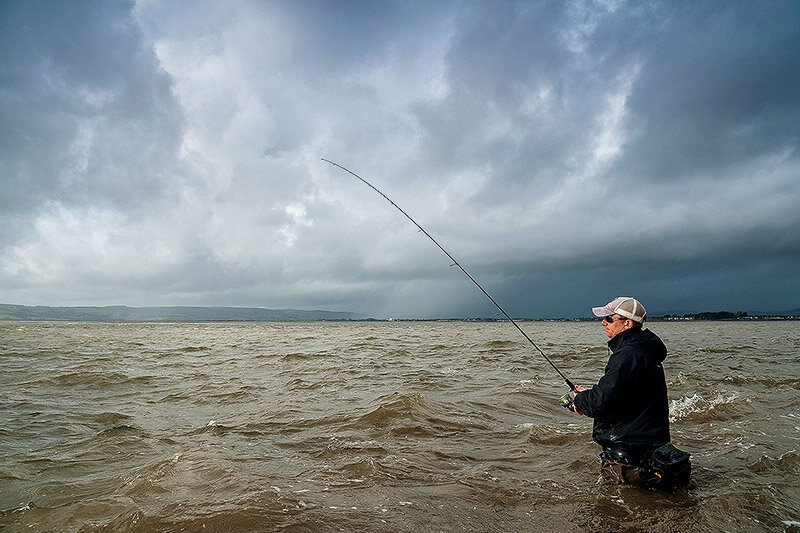
If there is one thing I feel uncomfortable about with my own lure fishing for bass, it’s dirty water, indeed I will do all I can to find clean water if where I had planned to fish doesn’t look that good clarity wise. I have obviously caught bass in water which I would describe as murky, but in general I will look for clear water and I accept that I have a lot to learn about trying to catch bass when the water doesn’t look great. I think about somewhere like the Bristol Channel and how I used to literally lose my peeler crabs in a bucket of water when I gave them a drink, but fish are feeding away quite happily. I know that lure fishing is of course based a lot more around sight, but do bass all suddenly sod off when the water gets a bit murky? Me thinks not, so surely the onus is on us to modify our approach? An angler I don’t know very well but who has caught some seriously big bass from some of the south west estuaries was telling me one day how he had been doing so much better now the rivers were more coloured from a lot of rain. What really fried my brain about hearing this was that I had walked away from fishing my local estuary at the exact time he was talking about because I didn’t fancy the water clarity.
I don’t know how many of you here follow the excellent New Zealand based blog and website Active Angling New Zealand, but if you don’t then you really should because it’s very good. For sure their fish are different and it’s obviously a completely different part of the world, but fishing is still fishing and I would always argue that on a global scale we have much to learn from each other. I see a number of anglers online fawning over the US striped bass fishing for example, and how amazing they must be as anglers across the pond because of the fish they catch. For sure it can be some amazing fishing, but striped bass grow much bigger than our bass so everything naturally looks more impressive anyway. Bearing in mind that I have seen a little bit of striped bass fishing and some anglers I know and trust have done a hell of a lot of it, well my argument would always be that in fact we should all be learning from each other.
Anyway, Alan who runs the Active Angling New Zealand blog and website recently put an article up called: “How turbidity affects fish behaviour”, and when I was reading it various lightbulbs were going off in my head about my own bass fishing and my limited knowledge and skills based around murkier water especially. It’s a fascinating read and it made so much sense, so I contacted Alan and asked him if he would mind if I reproduced his excellent article here on my blog. Thank you so much Alan for so kindly allowing me to do this, and I would urge all of you here to keep a close eye on his Active Angling New Zealand blog and website. Here goes then:
How turbidity affects fish behaviour
“For many years now I’ve noticed that catch rates are affected by the optical clarity of the water. Generally I have greater success if the water is optically clear than when it is murky or cloudy and full of suspended sediment. It is still possible to catch fish when the water is murky but it requires a change in tactics. More about that later.
Turbidity is a measure of the degree to which the water loses its transparency due to the presence of suspended particulates. The more total suspended solids in the water, the murkier it seems and the higher the turbidity.
There are various parameters influencing the murkiness of the water. Some of these are:
Tidal movement
Wind action
Phytoplankton
Sediments from erosion and urban runoff
Re-suspended sediments from the bottom caused by bottom feeders like carp
Waste discharge
Algae growth
Turbidity affects fish behaviour in several ways. Firstly, it makes it difficult for predators that rely on sight to catch prey. They can get close to targets using impulses received by their lateral lines (THE LATERAL LINE – A FISH’S SIXTH SENSE) but need good visibility to actually capture them by sight. This results in lower feeding efficiency and often a change in feeding strategy, especially for the predators who mainly eat smaller fish. As the turbidity increases predators move from a feeding strategy of chasing fast moving prey with a high chance of escape to a slow moving organisms with a low escape probability.

In the Manukau harbour this means that predators which normally feed on fish start to look elsewhere for food and become less selective. They switch to hunting worms, crabs and shrimps (known as macrobenthic prey) as they are easier to find. Kahawai and trevally both do this. It is especially noticeable over the winter as the flats are pock marked with holes at low tide and there are no snapper in the harbour to have caused the digging. If the water is murky, and you notice that the flat is covered in holes when you arrive, then attach a whirl tail soft plastic or crab imitation and retrieve it very slowly along the bottom. Fly fisherman should do likewise and dredge the bottom with a crab, worm or shrimp imitation.
Fish that mainly feed on worms and other crustaceans suddenly have more competition for food from the fish eaters and become slightly less selective in what they will eat. Fish, such as mullet, that feed on detritus are not as affected by turbidity which is why they are often visible feeding in close, even when the water is very murky.
Secondly, the suspended particles absorb heat from the sunlight, making turbid waters become warmer, and so reducing the concentration of oxygen in the water. As the water warms it slows the rate at which fish can digest food and this affects when they will next feed. What this means on the shallow saltwater flats is that fish which are susceptible to water temperature will shift to feed at high tide when the water is deeper and slightly cooler or, during summer, switch to feeding on the bottom at night. In freshwater, predators will seek out cooler thermoclines (often right on the bottom) or cooler, less turbid inflows into a lake. For more information on how water temperature affects feeding click on:- FISH DIGESTION AND HOW IT DRIVES FEEDING BEHAVIOUR
Thirdly, the suspended particles scatter the light which decreases the photosynthetic activity of plants and algae. This contributes to a lowering of the oxygen concentration even more. When this happens fish will leave an area and move to a cooler zone with higher levels of dissolved oxygen. If you want to read more on how changes in dissolved oxygen levels affect fish then click on:- HOW DISSOLVED OXYGEN AFFECTS FISH BEHAVIOUR
Finally as a consequence of the suspended particles settling to the bottom in shallow bodies of water fish eggs and larvae will be covered and suffocated and gill structures clogged or damaged. In freshwater rivers, especially when they are in flood, predators will actively seek out the margins or bottom, side branches off the main flow or clearer inflows where the water is marginally less turbid.
The key issue for predators feeding in turbid water is detecting a difference in contrast between their prey and the background murk. Brightness contrast is the determining factor for the visibility of objects underwater and objects must be lighter or darker than the background (reflect more or less light) to be seen clearly. This need for contrast is why black or dark lures are often recommended for use in turbid water. See the chart below:- (https://www.fix.com/blog/view-from-below-lures-underwater/)
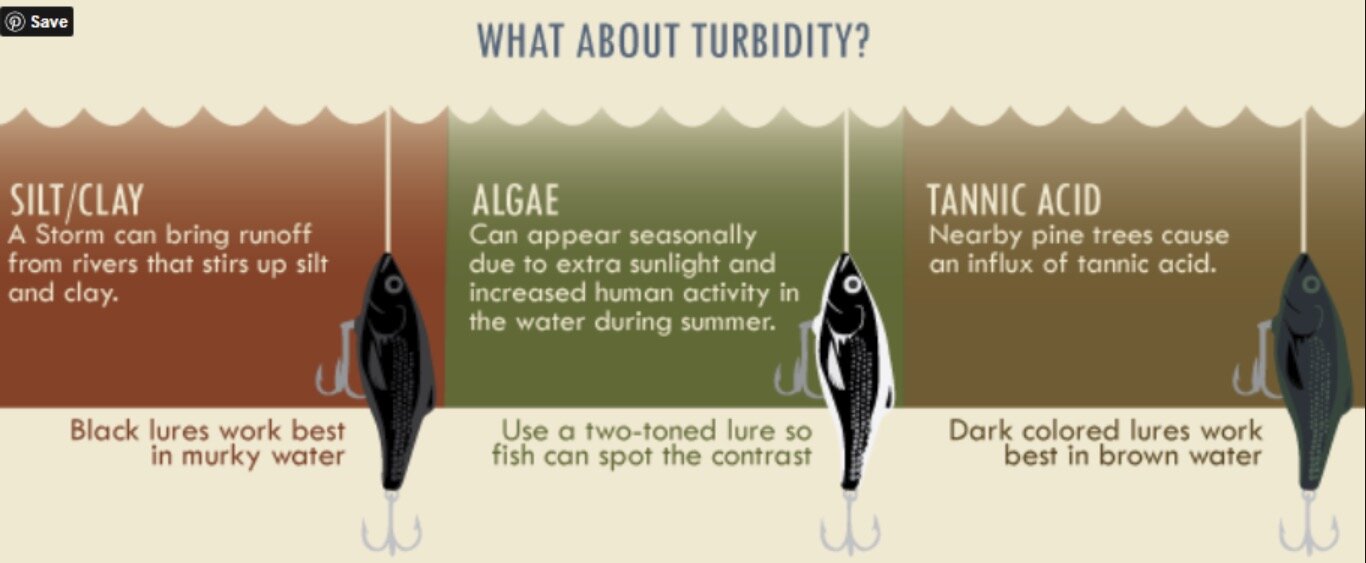
However, this only works if the light levels are medium – high. At low light levels the detection of prey is largely governed by absolute light levels rather than contrast. So if you are fishing on a very dull day try to find seams or pockets of water where the clarity is better and target these. Often predators will sit just inside the murky water so they are invisible to any concentrated schools of prey that pass. The other thing to do in this situation is to go deep with a high contrast paddle or whirl tail soft plastic and retrieve it along the bottom. The soft plastic needs to have a distinct “sonic fingerprint” so that it can be located by predators. For more information:- CHOOSING A LURE COLOUR TO SUIT THE CONDITIONS
One phenomenon which contributes significantly to turbidity in shallow estuaries is spring tides. Spring tides, specially king tides where the high tide levels are significantly higher than normal, lead to a phenomenon which I’ve named the “Vacuum cleaner” effect. Put simply, the volumetric flowrate of water off the flat as a spring tide starts to ebb is greater than normal and this “sucks” sediment off the bottom and into suspension. The effect is greatest in between the second and fourth hours of the outgoing tide as this is when 50% of the water in the estuary moves out. If you are fishing the estuary as it ebbs from high tide then you can often see it getting murkier as time goes on. When this starts to happen try to target the clearer pockets or seams of water as the fish will be close to these. The best time to fish shallow estuaries during king tides is in the run up to high tide and the first hour of outgoing as this is when the water clarity is at its optimum. If you want to learn more about tides click on:- TIDES AND SAFETY – THE RULE OF TWELFTHS
Turbid water is one of the few occasions where scented soft plastics may be useful but only if you are fishing in weak to moderate current flows and are retrieving slowly enough for the dissipated scent to be picked up by any nearby predators.
In summary, turbidity has a massive effect on the behaviour of predatory fish. If you can understand how their behaviour changes as the turbidity increases then you can target areas where they will likely be concentrated with lures that will give you the greatest chance of success. Being observant and identifying the signs that the fish are feeding on the bottom because the water is murky is the key.”
